“Oh the weather outside is frightful,”… but so is dead week. That being said we seem to be making some progress completing our final project. Here is the column I wrote for Tuesday’s issue of the Kansas State Collegian it’s about annoyances of the term Happy Holidays.
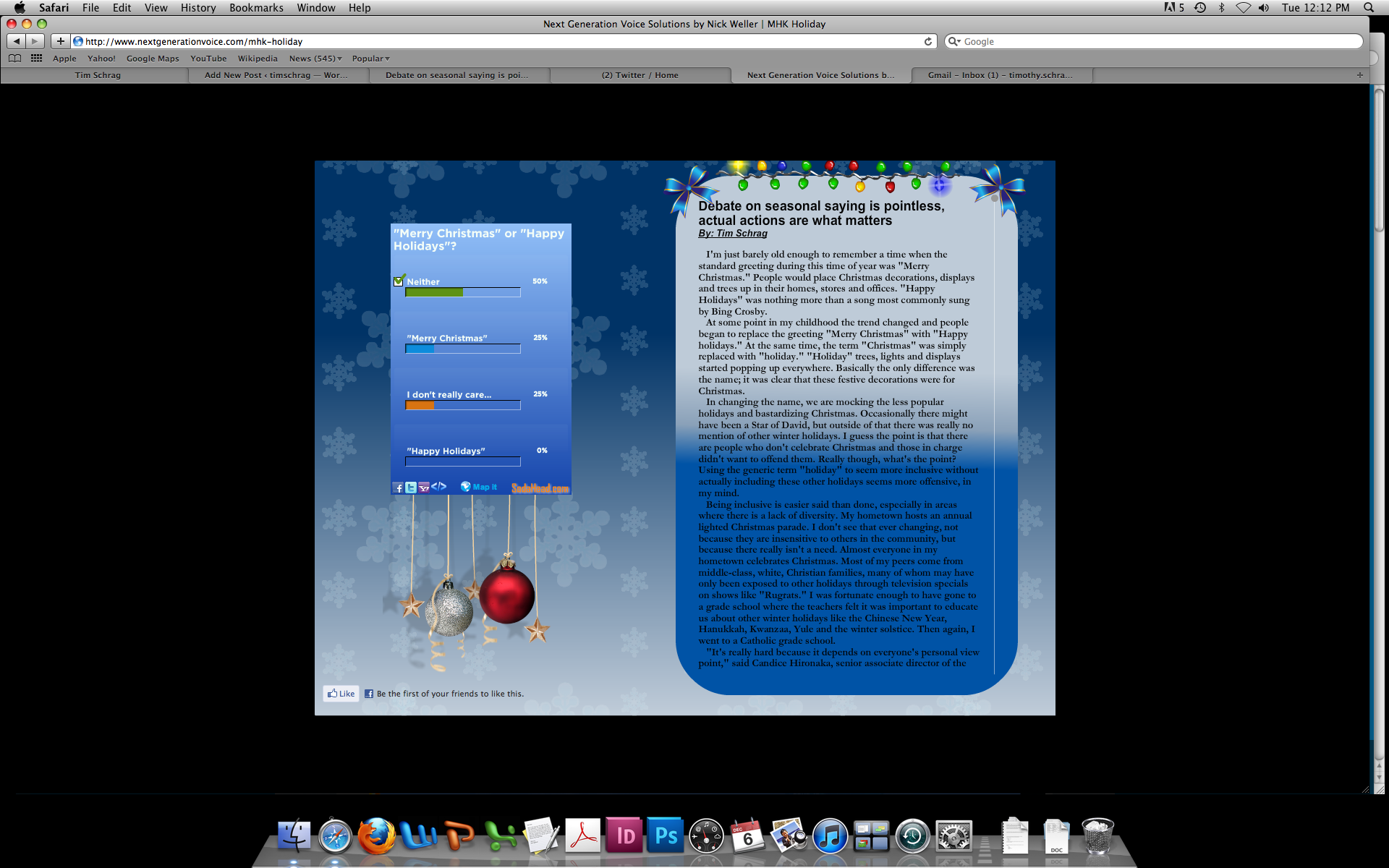
Debate on seasonal saying is pointless, actual actions are what matters
By: Tim Schrag
I’m just barely old enough to remember a time when the standard greeting during this time of year was “Merry Christmas.” People would place Christmas decorations, displays and trees up in their homes, stores and offices. “Happy Holidays” was nothing more than a song most commonly sung by Bing Crosby.
At some point in my childhood the trend changed and people began to replace the greeting “Merry Christmas” with “Happy holidays.” At the same time, the term “Christmas” was simply replaced with “holiday.” “Holiday” trees, lights and displays started popping up everywhere. Basically the only difference was the name; it was clear that these festive decorations were for Christmas.
In changing the name, we are mocking the less popular holidays and bastardizing Christmas. Occasionally there might have been a Star of David, but outside of that there was really no mention of other winter holidays. I guess the point is that there are people who don’t celebrate Christmas and those in charge didn’t want to offend them. Really though, what’s the point? Using the generic term “holiday” to seem more inclusive without actually including these other holidays seems more offensive, in my mind.
Being inclusive is easier said than done, especially in areas where there is a lack of diversity. My hometown hosts an annual lighted Christmas parade. I don’t see that ever changing, not because they are insensitive to others in the community, but because there really isn’t a need. Almost everyone in my hometown celebrates Christmas. Most of my peers come from middle-class, white, Christian families, many of whom may have only been exposed to other holidays through television specials on shows like “Rugrats.” I was fortunate enough to have gone to a grade school where the teachers felt it was important to educate us about other winter holidays like the Chinese New Year, Hanukkah, Kwanzaa, Yule and the winter solstice. Then again, I went to a Catholic grade school.
“It’s really hard because it depends on everyone’s personal view point,” said Candice Hironaka, senior associate director of the School of Leadership Studies. “It’s hard when your cultural frame of reference is steeped around one specific holiday. It’s just a matter of continuing to educate ourselves about what the other holidays are that are happening during this season of really good wishes.”
Hironaka says while she does celebrate Christmas, when she is greeting people around the office or in class she prefers the term “seasons greetings” because it is more generic and focuses more on well-wishing.
I’m totally on board with this idea. Still, I say “Merry Christmas” more often than not. I think it’s a good failsafe. In my opinion, “Happy holidays” is an empty statement. What most people are really saying is “Merry Christmas, but I don’t want to offend anyone so I’m saying this instead, even though I mean Merry Christmas.” I have run across very few people who say “Happy Holidays” and genuinely mean it.
Why not cut out the middle man and say “Merry Christmas” if that’s what the statement is meant to convey? “Season’s greetings” also works well, because it’s a greeting that could really be used at any time of the year.
Ultimately this season is a time for well-wishing and joy, and I sincerely hope people have an amazing December and January despite what they celebrate. The purple nation is a diverse crowd, and we should celebrate it, but not insincerely. Good luck with finals everyone, and when you greet each other, just say what you mean. It comes off less condescending.
Tim Schrag is a senior in journalism and digital media. Please send all comments to opinion@spub.ksu.edu.





 Tim Schrag